



The Jellyfishbot has been very beneficial to ExxonMobil in the Beaumont area.
What started as a benefit for our manufacturing site grew to benefiting our 3 main sites in the area (refinery, chemicals, polyethylene).
The Jellyfishbot does an excellent job of collecting polyethylene pellets for us, but we really saw tremendous benefits after we added bathymetry reporting.
We have been able to obtain the depth of various waterways in our facilities that were previously unknown or would have required an external contract crew to assess. The ability to rescan water depth on a regular frequency using our own team/pilots is allowing us to assess the health and level of our waterways at minimal cost to the facility and company.
The Jellyfishbot is easy to use, and the customer support from IADYS has been superb.

The Jellyfishbot plays a pivotal role in mitigating the amount of organic and inorganic solids that are in our site stormwater conveyance systems and reduce the risk of ergonomic stress and heat fatigue. The Jellyfishbot robots are designed to operate autonomously, and this autonomy means that they can tirelessly patrol our internal storm water systems, regardless of weather conditions.
By removing the need for humans to access water areas in hot and sometime emergency rain flood situations, the water skimmer robots contribute significantly to better worker safety. This shift towards automation not only reduces the physical challenges faced by crews but also allows human resources to be redirected toward more strategic and impactful roles within our operations.
The combination of their autonomous nature and advanced sensor technology enables these robots to navigate and operate in challenging environments with precision, minimizing any potential collisions with walls, existing assets, and sloped banks. This newfound ability to operate independently makes them a powerful and efficient tool. As a result, they not only tirelessly help filter out solids, but also improve the safety of those in charge of overseeing the operation.
We look forward to delivery of the next innovation, a floating docking station, which will allow the robot to dock itself when needed for charging.


The Jellyfishbot fits perfectly into our sustainability strategy.
We were looking for a practical solution to strengthen our environmental initiatives while making our teams' work easier. After two years of renting the Jellyfishbot, we experienced its effectiveness on a daily basis.
Its value quickly became undeniable, and purchasing a Jellyfishbot Abyss in January 2026 was the natural next step in our commitment to even more sustainable operations.


At the Marines de Cogolin, we are always looking for new solutions to go beyond simple port management.
That is why we use the Jellyfishbot. Our top priority is first and foremost to map our seabed: this gives us a precise view of what is happening beneath the surface, which is essential for monitoring the condition of our infrastructure.
Waste collection then becomes a complementary mission that allows us to further enhance the quality of our service.
By investing in this type of tool, we ensure that our port activity integrates as smoothly as possible into its ecosystem.


The Jellyfishbot has become a vital part of our toolkit in tackling the persistent issue of marine debris along our coastline and in our marinas.
It’s efficiency in removing hard-to-reach waste not only enhances our cleanup efforts but also provides a powerful opportunity to engage with and educate the community about the pressing reality of ocean pollution.

Around the Yokohama Hakkeijima Sea Paradise Park, marine debris continues to accumulate despite the installation of protective barriers. Manual clean-up by specialized companies was costly, which led us to look for a simpler and more cost-effective solution. Easy to use on a daily basis, the Jellyfishbot quickly stood out as the ideal option.
We also integrated it into the Tokyo Bay Wonder Watchers participatory program to raise awareness among visitors about the issue of marine litter.
At Umi Farm, the park’s outdoor aquarium, the Jellyfishbot was used during educational workshops for school groups. The activity was a great success, especially among children, by combining fun learning with awareness of marine pollution challenges.

As a dealer of IADYS in the Netherlands and Belgium, we are pleased to collaborate on the promotion and support of the Jellyfishbot.
Our partnership with IADYS has been extremely positive. The communication is always prompt, knowledgeable, and supportive. Their professionalism and commitment enable us to serve our customers effectively and contribute to cleaner waterways.
The Jellyfishbot is an innovative and reliable solution that aligns perfectly with our mission and services.


In Fairhaven, the Jellyfishbot has quickly become more than just a cleanup tool — it’s a community project. To encourage local ownership, the Town invited residents to help name the robot through an online poll and on-site voting during the Huttleston HarborFest event organized by Discover Fairhaven. After hundreds of submissions, the winning name was revealed at the festival: “Bumblebee.”
For Fairhaven’s team, the impact is already clear:
“The most visible impact will be a real reduction in floating trash. When I was the Conservation Agent, residents would constantly call me to show the sheer volume of debris in the harbor. Now, this robot can collect it before it ever reaches the shoreline. Over time, we hope it will also build a deeper sense of personal ownership of our coastline.”
Bruce Webb, Fairhaven

The Jellyfishbot, developed by IADYS, is revolutionizing plastic pollution research by helping the Université du Littoral Côte d'Opale (ULCO) detect and analyze floating waste in even the most hard-to-reach aquatic environments.
The exhibition “Ocean Futures” at Futurium, Berlin, explores the future of our oceans – focusing in particular on issues such as pollution, climate change, biodiversity, and sustainable fisheries.
It demonstrates the extent to which humans influence the oceans and highlights innovative approaches and technologies that can help preserve these vital marine ecosystems.
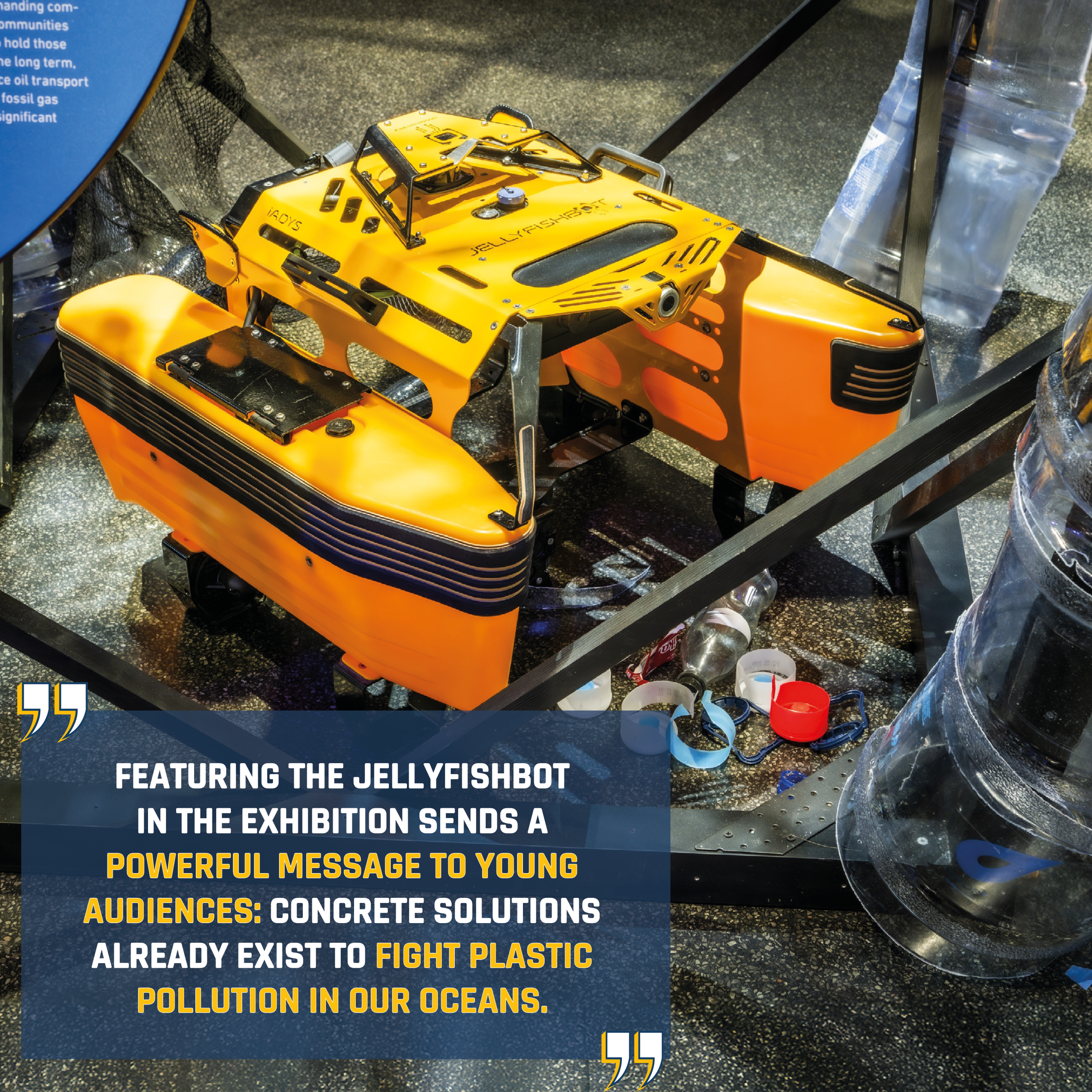
The Jellyfishbot exhibit is significant because it demonstrates a concrete, ready-to-use solution to marine pollution. Its presentation makes clear: Innovation plays a key role in protecting the oceans.
The Jellyfishbot, developed by IADYS, is revolutionizing plastic pollution research by helping the Université du Littoral Côte d'Opale (ULCO) detect and analyze floating waste in even the most hard-to-reach aquatic environments.
For several years, Professor Rachid Amara's team at the Université du Littoral Côte d'Opale (ULCO) in northern France has been conducting pioneering research on a crucial issue: the detection and identification of floating plastic waste in aquatic environments.
Until recently, researchers relied on traditional methods such as manual surveys or Manta nets towed by boats. But in 2021, a major breakthrough changed the game: the university acquired a Jellyfishbot, a robot developed and refined by the IADYS team. Tailored to meet the researchers' specific needs, this robot can sample both microplastics and macroplastics in various aquatic environments, even in the most hard-to-reach areas like ports, shallow rivers, estuaries, canals, and waterways.
This groundbreaking innovation offers significant advantages over conventional sampling methods. It has also led to new research findings, resulting in numerous scientific publications, particularly within the PhD projects of Gabriel Pasquier and Rosa Sawan. The Jellyfishbot is now a key asset in the European Interreg TREASURE project (Targeting the Reduction of Plastic Outflow into the North Sea).
